SESVA_Logo_CircleSESVA_Logo_Stacked Circle_RGB

SES Volunteers Association of Western Australia Incorporated

“Together we can; Together we will”

06/11/2026 – Important Notice Volunteer Hardship Scheme

Statewide TEAMS Meeting:

Emergency Services Volunteers Hardship Assistance Scheme

SES units across Western Australia are invited to join a statewide Teams meeting on Thursday, 3 December 2026 to learn more about the Emergency Services Volunteers Hardship Assistance Scheme and the support it can provide to emergency services volunteers experiencing financial hardship.

The scheme was established to give emergency services volunteers an opportunity to seek financial assistance during times of hardship. It is managed by a governing committee comprising representatives from the relevant volunteer associations.

For many volunteers, it is a support option they may have heard about but know little about. This statewide session is an opportunity to build greater awareness of the scheme, including eligibility, the application process, and the rights and responsibilities associated with seeking assistance.

These are among the areas covered in the scheme information available through the WA SES Volunteers Association website.

Why join the meeting?

Whether you are an SES volunteer, Unit Manager, welfare contact or someone who supports volunteers at the local level, the meeting is an opportunity to better understand the assistance available and help ensure volunteers know where they can turn when times get tough.

Thursday, 3 December 2026 Statewide online meeting via Microsoft Teams

Meeting time and TEAMS joining details to be provided.

Supporting our volunteers means making sure they know help is available when they need it most.

Learn more about the Emergency Services  volunteers Hardship Assistance Scheme

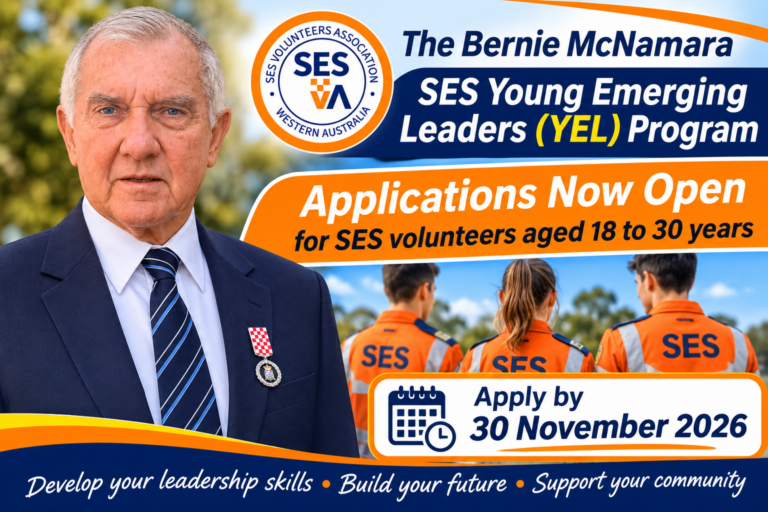
06/11/2026 – The Bernie McNamara SES Young Emerging Leaders (YEL) Program

Applications Now Open for SES volunteers aged 18 to 30 years apply by 30 November 2026 .

The Bernie McNamara SES Young Emerging Leaders (YEL) Program provides a valuable leadership development opportunity for young SES volunteers in Western Australia. Aligned with the National SESVA Young Emerging Leaders Program, the initiative enables two WA volunteers to participate in the annual National Memorial Service and associated leadership activities in Canberra.

One position is automatically awarded to the recipient of the WA Fire and Emergency Services SES Young Person of the Year Award , while the second participant is selected through a competitive application process managed by the WA SES Volunteers Association (SESVA)

Program Activities

  • While the program schedule may vary each year, participants can typically expect to:
  • Attend the AFAC National Memorial Service in Canberra.
  • Meet senior leaders from across Australia, including the Governor-General and Commissioners of emergency services agencies.
  • Visit key national institutions such as Parliament House, Geoscience Australia, and the National Emergency Management Agency (NEMA)
  • Share their experience with the wider SES community by contributing an article to the SESVA Newsletter following their return to Western Australia.

Eligibility and Application Requirements: To be eligible for consideration, applicants must:

Be a registered WA SES volunteer aged between 18 and 30 years as at 30 November 2026.

  • Obtain a written reference from the Local Manager of their SES Unit.
  • Submit a completed application form to the WA SESVA Secretary at office@ses-wa.asn.au.

The application form requires applicants to provide information about:

  • Their SES, community and leadership involvement.
  • Leadership aspirations and future goals.
  • How they see themselves developing as a leader over the next five years.

Selection Process

Selection is based on demonstrated achievement, leadership potential and commitment to the SES. Applications will be assessed by an independent selection panel chaired by a member of the SESVA Management Committee.

Download the Application Form here

Key Dates
30 November 2026 – Applications close

14 December 2026 – Successful applicant(s) announced

Late April 2027 – Participation in the Memorial Service and leadership program in Canberra

05/11/2026 – From the SESVA President November 2026

Hello again to you all

As we approach the 2026/2027 high-threat period, it is important that we prepare not only for the operational demands ahead, but also for the protection, health and wellbeing of every WA SES volunteer.

Our work places us in challenging and sometimes hazardous environments. Flooding, storm damage, extreme weather, heat, unstable structures, fallen trees, difficult access and long operational periods can all place significant demands on our people. Unit member protection must therefore remain central to our preparation.

Being ready means maintaining the skills and knowledge required to work safely in emergency environments. This includes understanding operational procedures, using personal protective equipment correctly, identifying hazards, communicating effectively, working within our capability and knowing when to stop, withdraw or seek additional support.  No task is more important than the safety of the people undertaking it.

Preparation must also include our physical and physiological readiness. High-threat operations can involve extended periods of physical effort, disrupted sleep, exposure to heat and weather, heavy lifting, awkward movements and limited access to food, water or rest. Volunteers should consider how they will maintain their health and energy during these conditions.

Practical preparation may include:

  • building and maintaining an appropriate level of fitness;
  • getting adequate sleep before periods of heightened activity;
  • maintaining hydration and carrying suitable water supplies;
  • eating regularly and choosing food that supports sustained energy;
  • preparing for heat exposure and other environmental conditions;
  • checking medications, medical needs and personal equipment;
  • understanding the signs of heat stress, fatigue, dehydration and physical overexertion;
  • using safe manual-handling techniques; and
  • taking scheduled breaks and reporting concerns early.

Looking after ourselves is not a sign of weakness or a lack of commitment. It is an essential part of being operationally effective.

A fatigued, dehydrated or injured volunteer is at greater risk and may also create additional risk for their team. We must be prepared to speak up when we are not fit for a task, and we must support our colleagues when they do the same.

Preparation should also include our mental and emotional wellbeing. Emergency work can expose volunteers to distressing situations, uncertainty and pressure. Staying connected with our team, checking in with one another, participating in briefings and debriefings, and seeking support when needed are all important protective measures. Early support is always preferable to waiting until concerns become overwhelming.

Importantly, our preparation must include our families and loved ones. They should not be left out of the process.  Families need to understand that deployments may involve long hours, limited communication, changing rosters and possible exposure to difficult conditions. Discussing these realities in advance can help everyone feel more informed and supported.

Simple steps can make a difference: talk about likely commitments, agree on communication arrangements, identify who can assist with household responsibilities and make sure loved ones know where support can be found if an operation affects normal routines. Our families are part of the broader support network that enables volunteers to serve their communities.

The coming high-threat period will require professionalism, teamwork and resilience. Let us make unit member protection a shared responsibility from training and equipment checks, through to deployment, recovery and return home.

Every volunteer should return from an operation as safely and as well as possible. By preparing our skills, our bodies, our minds and our families, we strengthen not only individual volunteers, but the whole WA SES network.

Stay prepared. Stay connected. Look after yourself—and look after each other.

Greg Cook ESM
President, WA SES Volunteers Association of Western Australia Incorporated
05/11/2026 – SESVA News Update November 2026

Articles in this Month's Edition

Click the Newsletter button above to read these articles

In this months newsletter you will find interesting and informative news items including:

  • From the SESVA President
  • SESVA AGM and delegates form
  • EOIs for 70th Anniversary working group
  • Security warning for SES unit websites
  • Fuel Card funding for volunteers
  • Applications Open for YEL program
  • North or South, Summer means be ready
  • Statewide TEAMS meeting re Hardship Scheme
  • Demential Training for first responders
  • Bayswater SES Long Service Awards
  • Mandurah SES Celebrates 50th Anniversary
  • Upcoming Events & Important Dates


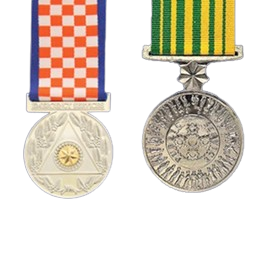
13/10/2026 – Do You Qualify for the National Emergency Medal?

The National Emergency Medal (NEM) recognises Australians who have provided significant or sustained service in response to a declared nationally significant emergency. Eligibility is determined separately for each declared event, with specific criteria relating to dates, locations, duration of service and the nature of the role
performed.

For many emergency service volunteers, including SES members, the first step is to consider whether they were involved in one of the declared emergencies and whether their service occurred during the official response phase.  Service does not need to have been performed on the frontline. Operational support, communications, intelligence, logistics, evacuation centre operations and other roles that directly facilitated the emergency response may also be eligible.

There are two pathways to recognition:

Sustained Service

Awarded to those who served for a minimum period during a declared emergency. The required duration varies for each event and must fall within the specified dates of the declaration.

Significant Service

Awarded for extraordinary service that goes above and beyond normal expectations. Nominees under this category do not need to meet the minimum service duration requirements and are assessed individually by the National Emergency Medal Committee.

The nationally significant emergencies declared to date include:
• Victorian Bushfires 2009
• Queensland Floods 2010-11 and Cyclone Yasi
• Tropical Cyclone Debbie 2017
• North Queensland Floods 2019
• Bushfires 2019-20
• Floods February 2022
• Floods November 2022

Check Your Eligibility

Ask yourself:


• Did I serve during one of the declared emergencies?
• Was my service performed during the response phase?
• Did I meet the minimum duration requirements for that event?
• Did my role directly support or facilitate the emergency response?
• Have my deployment or service records been captured by my organisation?

If you answered yes to these questions, you may be eligible for the National Emergency Medal.

For SES volunteers, this is an excellent opportunity to review your service history and ensure your organisation has accurate records of your deployments and support activities.

Recognition through the National Emergency Medal acknowledges the commitment, sacrifice and professionalism demonstrated during Australia’s most
significant emergencies.


For more information, visit the Governor-General’s National Emergency Medal pages and review the criteria for the specific emergency in which you served. https://www.gg.gov.au/australian-honours-and-awards/national-emergency-medal

11/10/2026 – Albany SES Volunteers Represent WA at National Disaster Rescue Challenge

Flying the Flag for Western Australia 

Western Australia was proudly represented at the 2026 National Disaster Rescue Challenge (NDRC) by volunteers from Albany SES. 

Hosted by the Queensland State Emergency Service on the picturesque Atherton Tablelands in Far North Queensland, the challenge brought together more than 300 SES volunteers and staff from across Australia to test their skills, share knowledge and build connections across jurisdictions. 

Joining the WA contingent as observers were SESVA President Greg Cook ESM and DFES Assistant Commissioner Paul Carr ESM, providing an opportunity to witness first-hand the outstanding capability and professionalism of SES volunteers from around the nation. 

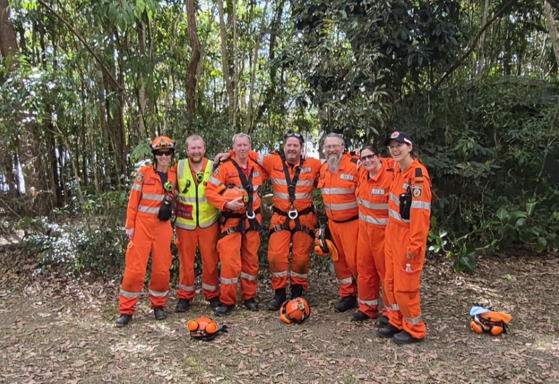
Albany SES team members at the NDRC. From L to R: Kate Pritchett, Ben Whittle, Nigel De Snoo, Gavin Murdock, Paul Bloffwitch, Kathy Way and Jessica Rouse. Photo by Kevin Madden

Realistic Rescue Scenarios, Real-World Skills 

The challenge featured eight demanding scenarios designed to replicate the types of emergencies SES volunteers face in their communities every day. Teams tackled a diverse range of incidents including: 

  • Mass casualty and USAR operations involving a hot air balloon emergency. 
  • Boat rescue scenarios with multiple casualties. 
  • Navigation and search tasks. 
  • High ropes rescues. 
  • Storm damage incidents involving leaking fertiliser tanks. 
  • Casualty rescues from mountain bike accidents and other complex environments. 
  • A non-scoring entrapment and test-release rescue exercise focused on learning and skill development. 

Every scenario tested leadership, communication, technical rescue skills and teamwork under pressure, providing valuable learning opportunities for all participants. 

More Than a Competition 

While the rescue scenarios were a highlight, the NDRC offered much more than practical skills training. Learning stands at Lake Tinaroo Hall showcased Indigenous culture, traditional dance and cultural burning practices, giving participants a deeper appreciation of Australia’s rich heritage and the role of traditional land management in disaster resilience. 

Many volunteers described the cultural experiences as a true “wow factor” that added another dimension to the event. 

Celebrating Excellence 

Congratulations to Gold Coast City SES Unit for taking out the overall championship. New South Wales finished second, with Victoria claiming third place. 

Special recognition also goes to Tasmania, which was awarded the prestigious Hori Howard Spirit of the Challenge Award, celebrating teamwork, camaraderie and commitment to the values of the National Disaster Rescue Challenge. 

Flying the Flag for WA 

For the Albany SES volunteers who attended, the NDRC was a unique opportunity to test their skills alongside some of the best SES operators in Australia, share knowledge with fellow volunteers, and bring home new ideas and techniques that can benefit communities across Western Australia. 

The experience reinforced what many already know: the strength of the SES lies in its volunteers and their willingness to continually learn, adapt and support one another. 

Looking Ahead 

If this year’s challenge is anything to go by, the 2028 National Disaster Rescue Challenge in South Australia will be an event not to miss. 

To the Albany SES volunteers and all WA participants, thank you for proudly representing Western Australia and demonstrating the professionalism, dedication and community spirit that make the SES such a respected organisation nationwide. Well done! 

Comment from Greg Cook ESM

President, SES Volunteers Association of Western Australia Incorpoarated (SESVA)

I would like to congratulate all the teams who competed in the National Disaster Rescue Challenge and acknowledge the outstanding skills, professionalism and dedication demonstrated by SES volunteers from across Australia.

Congratulations to the Gold Coast City SES Unit on winning the overall championship, with New South Wales finishing second and Victoria third. Special congratulations also go to Tasmania for receiving the prestigious Hori Howard Spirit of the Challenge Award, recognising the teamwork, camaraderie and commitment that make this event so special.

I would also like to commend the Albany SES volunteers and all Western Australian participants for proudly representing WA. Their participation provided a valuable opportunity to test their skills, share knowledge with fellow volunteers and bring home new ideas and techniques that will benefit SES Units and the communities they serve.

Events such as the National Disaster Rescue Challenge demonstrate that the strength of the SES lies in its volunteers, their willingness to continually learn and improve, and their commitment to supporting one another.

On behalf of SESVA, thank you to everyone who represented Western Australia with such pride and professionalism. You are excellent ambassadors for our State and for the SES.

I look forward to seeing our WA volunteers continue to build on this experience as we look towards the 2028 National Disaster Rescue Challenge in South Australia.

Well done to everyone involved!

Greg Cook ESM
President
SES Volunteers Association of Western Australia Incorporated (SESVA)