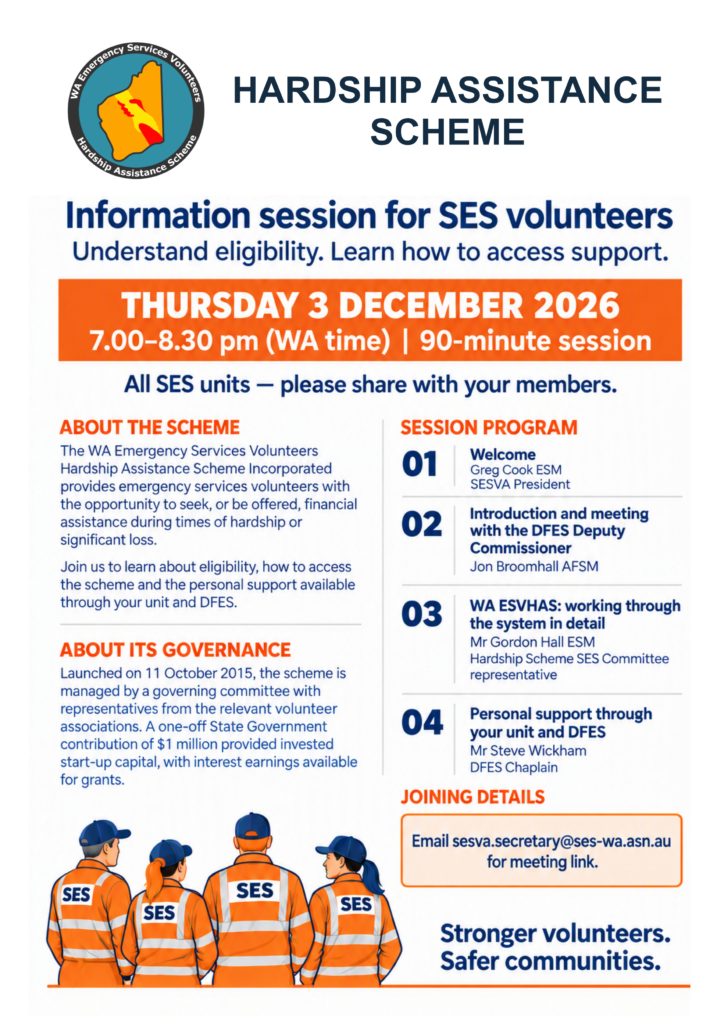
Purpose: An information session for State Emergency Service (SES) volunteers to understand eligibility criteria and learn how to access financial and personal support.
Date & Time: Thursday, 3 December 2026, from 7:00 pm to 8:30 pm (WA time).
Support Offered: Provides emergency services volunteers with financial assistance during times of hardship or significant loss.
Governance & Funding: Launched on 11 October 2015, it is managed by a governing committee representing relevant volunteer associations. It was established with a $1 million State Government contribution, using interest earnings from the invested capital to fund grants.
Session Program
Welcome: Greg Cook ESM (SESVA President)
Introduction & Meeting: Jon Broomhall AFSM (DFES Deputy Commissioner)
System Walkthrough (WA ESVHAS): Mr Gordon Hall ESM (Hardship Scheme SES Committee representative)
Personal Support (Unit & DFES): Mr Steve Wickham (DFES Chaplain
Greg Cook ESM President’s Report reviews a year in which SESVA continued to represent, advocate for and develop its volunteers.
Highlights include a three-year DFES grant agreement, progress on Fit-for-Role discussions, stronger regional representation and the start of a new strategic plan.
SESVA kept pushing for better vehicles, equipment, uniforms, training and volunteer support, and honoured SES volunteers through awards and community initiatives.
Next year, SESVA will aim to strengthen the organisation, improve communication, increase member participation, and ensure volunteers have a strong voice in decisions about their future.
Overall, the report affirms SESVA’ s commitment to keeping Western Australia’s SES volunteers informed, recognised, represented and supported.
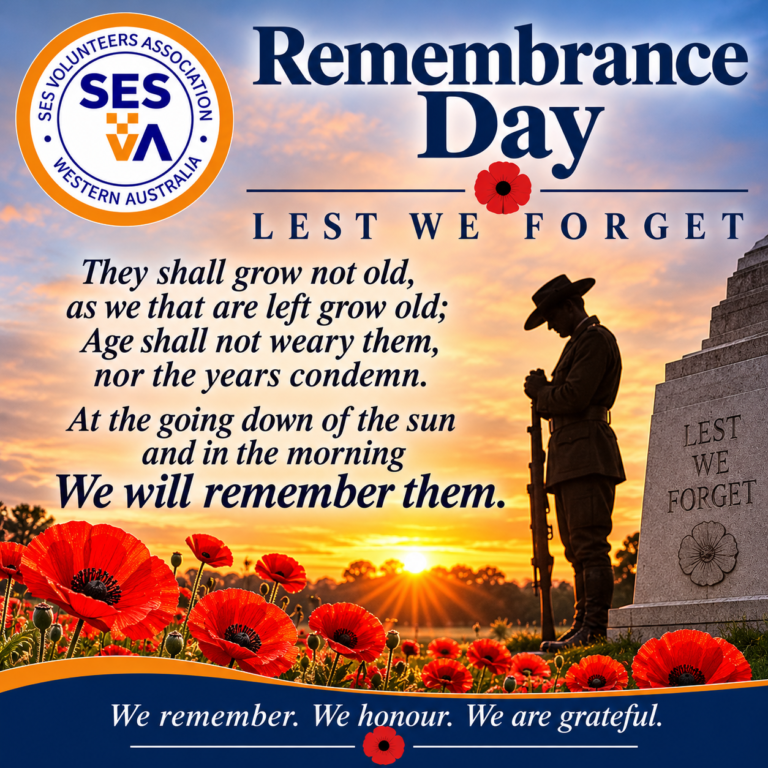
Today, on Remembrance Day, we pause to remember and honour the men and women who have served our nation and those who made the ultimate sacrifice in defence of our freedom.
On behalf of the SES Volunteers Association of Western Australia Incorporated (SESVA), I pay tribute to all Australian service personnel, past and present, whose courage, dedication and selflessness have helped shape the country we are privileged to call home.
We also remember the families who waited, supported, and endured the hardships of service, and those who continue to carry the memories of loved ones lost.
As volunteers, we understand the importance of service to others and the commitment to protecting our communities. We recognise that these values are shared by all who have worn our nation’s uniform.
Today, we remember their service, honour their sacrifice, and reflect on the freedoms we enjoy because of them.
They shall grow not old, as we that are left grow old.
Lest We Forget.
Greg Cook ESM President SES Volunteers Association of Western Australia Incorporated (SESVA)
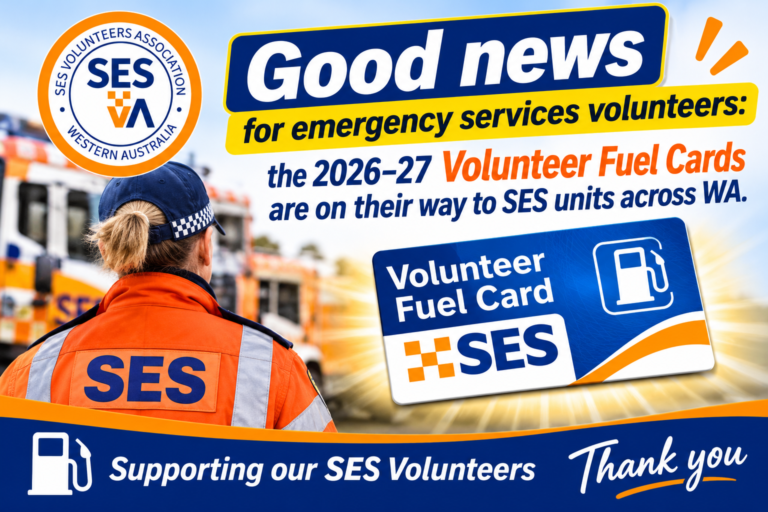
Good news for emergency services volunteers: the 2026–27 Volunteer Fuel Cards are on their way to SES units across WA.
DFES has arranged for the cards to be sent to the Unit Manager; eligible volunteers share them rather than receiving individual cards.
The State Government has allocated $1,000 per brigade, group or unit. The cards can be used for fuel for private or recreational purposes only, not for operational vehicles or vessels.
They are valid until 30 June 2027, so units are encouraged to keep track of expenditure throughout the year.
For full details, terms and conditions and support information, visit the DFES information page below.
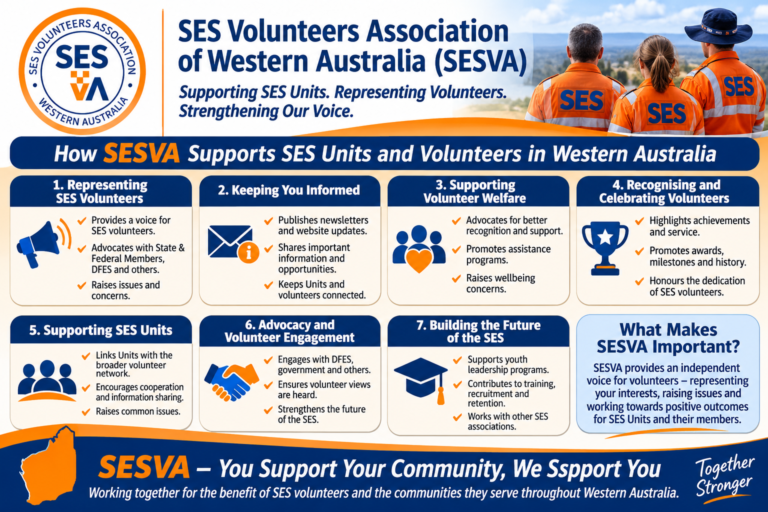
How SESVA Supports SES Units and Volunteers in Western Australia
The SES Volunteers Association of Western Australia Incorporated (SESVA) is the independent representative body working to support, represent and advocate for the interests of State Emergency Service volunteers across Western Australia.
SESVA gives volunteers a voice, keeps them informed, recognises their contribution, and works to ensure organisations and decision-makers responsible for the SES hear their views and concerns.
Our key areas of support
Representing SES Volunteers
Represents the interests and views of SES volunteers across Western Australia.
Provides an independent voice to State and Federal Members of Parliament, Local Government, DFES and other relevant organisations.
Raises issues and concerns affecting volunteers and their communities.
Keeping SES Units and Volunteers Informed
Publishes regular SESVA newsletters and website updates.
Shares important information, announcements, opportunities and developments affecting volunteers.
Provides a communication channel between SES Units, volunteers and the wider emergency services community.
Supporting Volunteer Welfare
Advocates for improved recognition, welfare and support for volunteers.
Promotes awareness of assistance programs and hardship support available to volunteers.
Raises matters affecting volunteer wellbeing and the sustainability of SES volunteering.
Recognising and Celebrating Volunteers
Promotes the achievements and dedication of SES volunteers.
Highlights volunteer awards, milestones, long service and unit achievements.
Supports the preservation of SES history and heritage in Western Australia.
Supporting SES Units
Provides a link between individual SES Units and the broader volunteer network.
Encourages communication, cooperation and sharing of information between Units.
Raises common issues affecting Units and their members.
Advocacy and Volunteer Engagement
Engages with DFES, government and other organisations on matters affecting volunteers.
Provides opportunities for volunteers to have their opinions and concerns heard.
Works to strengthen the future of the SES volunteer organisation in Western Australia.
Building the Future of the SES
Supports youth leadership and development opportunities, including the Young Emerging Leaders Program.
Contributes to discussions about volunteer training, qualifications, recruitment and retention.
Works with other State and Territory SES Volunteer Associations on issues affecting volunteers nationally.
What makes SESVA important?
SESVA provides something every volunteer organisation needs: an independent voice for its volunteers.
SESVA is not an operational arm of SES and does not direct emergency responses. Its role is to represent volunteers, raise issues, encourage consultation and work towards positive outcomes for SES Units and their members.
Through its Executive, Management Committee and Regional Representatives, SESVA works to ensure that the experiences, views and concerns of volunteers throughout Western Australia are heard.
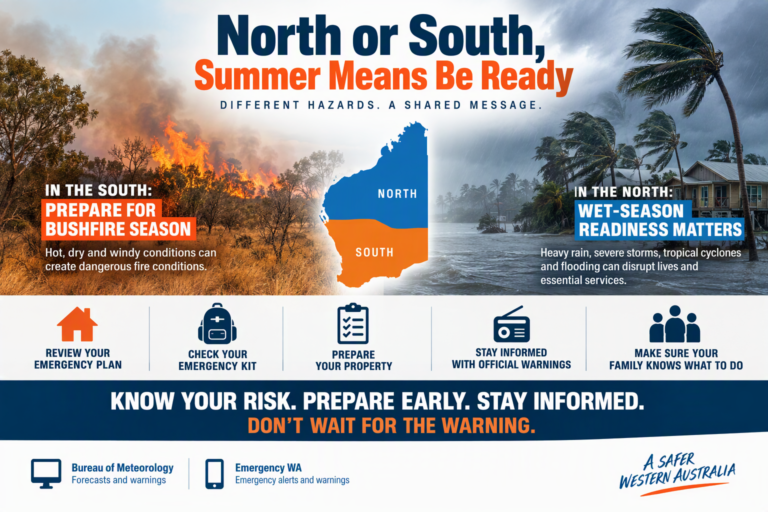
As southern Western Australia prepares for a dangerous bushfire season, the north is entering the wet season, bringing the threat of tropical cyclones, severe storms and flooding. The hazards may differ, but the message for SES volunteers and the communities we support is the same: prepare early and stay informed.
In the south: Prepare for bushfire season
Across the southern half of the State, dry conditions are adding to concerns about the coming bushfire season. Hot, dry and windy weather can create dangerous fire conditions, making preparation a priority before summer takes hold.
For volunteers, readiness starts at home. Review your household emergency plan, prepare your emergency kit and make sure your family knows what to do if a bushfire threatens. Follow official property-preparation advice and keep across local Fire Danger Ratings, restrictions and warnings.
In the north: Wet-season readiness matters
Northern communities are entering the time of year when heavy rainfall, severe thunderstorms and tropical cyclones can disrupt lives and essential services. Australia’s official tropical cyclone season runs from November to April, although cyclones can occur outside these months.
Damaging winds, flash flooding, road closures and isolation can create significant challenges for communities and responding SES Units. It only takes one cyclone or tropical low to cause serious impacts, regardless of how active the season is overall.
Now is the time to review emergency plans, check emergency supplies and prepare properties in line with official cyclone and flood advice.
Different hazards, shared operational awareness.
Seasonal outlooks help describe broader conditions, but they cannot pinpoint where and when individual emergencies will occur. Shorter-range forecasts, warnings and tropical cyclone track information become especially important as weather systems develop.
For SES volunteers, monitoring changing conditions provides valuable context for operational briefings and helps Units anticipate potential demands. Forecasts and public warnings complement, rather than replace, official operational advice and tasking.
Stay informed this summer.
Monitor Bureau of Meteorology forecasts and warnings, including the seven-day tropical cyclone forecast and cyclone track maps when issued. Follow Emergency WA for emergency alerts and warnings, and check local Fire Danger Ratings and restrictions.
Whether facing fire in the south or storms, cyclones and flooding in the north, being prepared matters across the State.
Monitor forecasts and warnings through the Bureau of Meteorology website and app, and emergency alerts through the Emergency WA website and app.