SES Volunteers Association (SESVA) President Greg Cook ESM and Vice President Alan Hawke met with the DFES Assistant Director, Marine Services, Mark Eatts, for an update on the implementation of proposed new training requirements for SES flood rescue boat operators and crew.
Background
SESVA recently circulated a Position Paper to affected SES units summarising SES unit feedback on proposed changes to flood rescue boat (FRB) operator training and certification requirements arising from Australian Maritime Safety Authority (AMSA) regulatory changes.
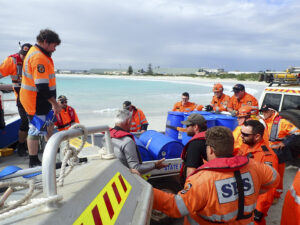
Flood boat rescue is a specialist capability conducted by 16 of WA’s 64 SES units and relies heavily on skilled volunteers. While SES flood boat operators currently undertake extensive training, competency maintenance, and operational currency requirements through DFES, recent changes to the National Law governing domestic commercial vessels have introduced additional qualification and compliance obligations.
The Position Paper includes 26 concerns that affected SES units had about the national standards and how DFES might implement any changes affecting SES volunteers.
If you want to read the Position Paper, It’s available on the SESVA website.
Scope
The scope of the consultations is limited to SES FRB operations. It does not include swift water rescue operations.
Why is Marine Rescue Service involved?
When DFES became aware of the changes to national standards, the Manager Marine Services was approached for guidance.
SESVA has been assured that changes to SES FRB training competencies is not about a take-over of SES FRB operations by Marine Rescue Service. There are however
some overlap of Marine Rescue and SES training packages. Competency requirements and synergies with training expertise and skills make for Marine Rescue Service to facilitate consultations.
What has changed
New Safety Management System
The changes to national standards allow scope for exemptions that relieve much of the onerous national requirements until 2030. In the meantime, SES FRB must
additionally implement a Safety Management System for FRB operations.
To assist affected SES units, DFES has prepared a draft template Safety Management System for affected SES units. The template is the basis for SES units to build their
own Safety Management System. The template is not a directive. SES units need to tailor the template to meet local operational circumstances.
If there are any affected SES units that have not yet implemented a Safety Management Plan, SESVA recommends you contact their regional natural hazards district officer.
National Training Standards for Trainer Assessors
The sting in the tail on current training exemption requirements affecting SES FRB training is that Trainer Assessors (TAs) are now required to have a Certificate IV in
Training and Assessment (TAE40110/116/122). DFES TAs are not certified in that national qualification.
SESVA is advised that Certificate IV in Training and Assessment is open to volunteer trainers. However, there are significant financial and time difficulties for volunteers to
be accredited. DFES is not accredited to deliver that training, so it will have to be obtained from an outside training provider. One idea being floated is that District
Officers be accredited and supervise and or assess training delivered by DFES endorsed FRB volunteer trainers. Also, there are existing volunteers with Cert IV accreditation.
Conclusion
For the time being, SESVA is monitoring the situation and open to facilitating communications with affected SES units wherever possible.
SESVA has asked for a written response to all concerns raised by affected SES units.
SESVA welcomes DFES providing a management plan on the implementation of national standards for SES FRB operations that covers all DFES commands, including an
appropriate single senior coordinating officer.
Alan Hawke
Vice President, SES Volunteers Association of Western Australia Incorporated